

In the early morning of 7 March, a team composed of four Tebtebba Foundation staff and five members of the Nagkakaisang mga Tribu ng Palawan (NATRIPAL) traversed the tree-lined highways of Palawan from Puerto Princesa to Roxas to meet with the Batak, one of the Indigenous Peoples of Palawan. The Senior Citizens Hall in Barangay Caramay, Roxas briefly became abuzz as they arrived and exchanged greetings with the Batak who came to attend the community assembly set by Tebtebba through NATRIPAL.
The Batak participants came from sitios Nanabu and Timbuan in Barangays Caramay and Abaroan, two of 31 barangays of Roxas municipality. Batak, the name given to the tribe by the Cuyonons, means “people of the mountains”. The Cuyonon is an ethnic group populating the Cuyo Islands northeast of mainland Palawan and the mainland’s northern and central parts.
The Batak were originally settled along the beautiful coastline and river valleys northeast of the capital Puerto Princesa, which over time migrants occupied, gradually pushing the peaceful and non-confrontational Batak people to higher elevations and forcing them to abandon their ancestral lands. This displacement has greatly affected their livelihood, as the Batak mostly hunter-gatherers live off the diverse and abundant food sources of the fertile river valleys and coasts. According to Johnson (2025), only an estimated 450 Batak people remain in Palawan, composed of approximately 50 family groups making them the smallest of the Indigenous groups in Palawan. Over the years, the vanishing tribe of Batak has endured food scarcity, the growth of outsider populations and limited access to work opportunities (Johnson, 2025).
Currently, Palawan’s tourism sector promotes the Batak Village Tour, which offers a guided full-day experience to visit and interact with the Batak people. The tour includes a jungle trek, river and stream crossings, as well as opportunities to engage with locals to learn about their culture through songs and dances, traditions and handicrafts. Tourists are given the chance to observe traditional hunting techniques while enjoying the lush terrain and natural beauty surrounding the village. Moreover, the tour helps in raising awareness of the Batak’s situation and provides a venue for marketing and selling their crafts and other goods, a primary source of income along with the harvesting of copal, a resin often sold to companies for use as a type of varnish (Batak Tribe Village Tour, n.d.; Turtle, 2023).
Community Assembly
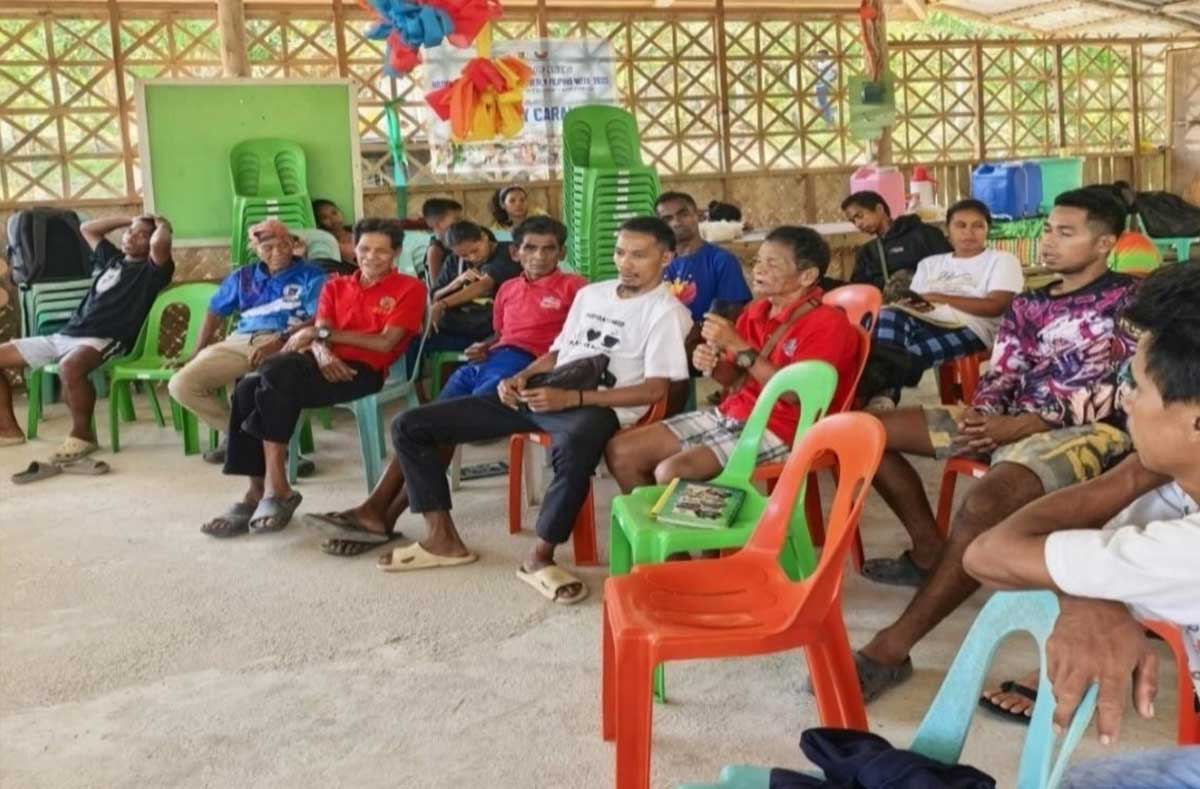
The community assembly began with a prayer in Binatak, a Batak language, led by Lagwasan Loreto Magbanua, an 85-year-old elder and spiritual leader (Lagwasan). Sonny dela Cruz, President of Samahan ng mga Katutubong Batak sa Nanabu (SKBN) then gave a heartwarming welcome, setting a positive tone for the rare occasion of Tebtebba staff’s engagement with the Batak. He shared that the annual traditional Daes, a tradition that embodies their identity, unity and cultural pride, had just concluded in Nanabu and was also being prepared in Timbuan. This year’s theme, Pagparimamenti, Pagpamanggad it Kultura reaffirmed the importance of preserving and appreciating the traditions that keep their community vibrant.
The annual celebration of Daes serves as one way to preserve and transmit Indigenous knowledge systems and practices among the Batak youth signifying the legacies of the past that are still alive today. These include bilao-making, mat and bag weaving, crafting of bows, cultural dances and songs.
Rey Pura, the municipal Indigenous Peoples Mandatory Representative (IPMR) and NATRIPAL board member, expressed his gratitude to all the participants and talked about the recent consultation with NATRIPAL. He stressed the importance of reviewing the “Gabay sa pagpili ng IPMR” (Guidelines in choosing the IPMR), noting that tribes like the Cuyoanon have expressed interest in this official position.
The Indigenous political structure of the Batak consists of 16 Tribal Council of Leaders referred to as Bagelar. Notably, the Batak have three Indigenous Peoples’ organizations: Samahan ng mga Katutubong Negrito sa Pilipinas (SKNP), Samahan ng mga Katutubong Batak sa Nanabu (SKBN) and Kururuyan ka Batak ka Sitio Timbuan (KKBT).
After a brief self-introduction by each participant, Roger Lambino shared about Tebtebba Foundation, or the Indigenous Peoples’ International Centre for Policy Research and Education. He explained that Tebtebba is a word used by the Kankana-ey, one of the Indigenous Peoples in northern Philippines, that refers to a process of collectively discussing issues and diverse views with the aim of reaching agreements, common positions and concerted actions. Tebtebba was established in 1996 by Ms. Victoria Tauli-Corpuz, former United Nations Special Rapporteur on the Rights of Indigenous Peoples, together with her colleagues to address the urgent need for protecting the inherent rights of Indigenous Peoples, raise awareness about their situations and support their self-determined development.
Under Corpuz’s leadership until her retirement in 2025, Tebtebba actively engaged in the processes that led to the adoption of international human rights instruments, policies and agreements, which include the UN Declaration on the Rights of Indigenous Peoples (UNDRIP), and contributed to the establishment of spaces where Indigenous Peoples can engage within the United Nations. Today, Tebtebba continues to work with partners in Africa, Asia and Latin America to ensure Indigenous Peoples’ voices are heard in global decision-making processes, with Helen Biangalen-Magata, a member of the Kadaclan Indigenous community in Paracelis, Mountain Province in the Cordillera Administrative Region.
Subsequently, John Mart Salunday, NATRIPAL Vice-Chairman and President of the Ugnayang Pambansa para sa Katutubong Kaalaman at Talino (UPAKAT) talked about UPAKAT—a national network of Indigenous political structures, Indigenous Peoples’ organizations and Indigenous communities. He said UPAKAT was formed to strengthen the protection, promotion, collective practice, innovation and transmission of indigenous knowledge systems and practices to the next generation. Registered with the Securities and Exchange Commission in 2016 after finalizing its constitution and by-laws, UPAKAT is composed of thirteen members, ten in Mindanao and three in Luzon.
Salunday, also a recent Presidential appointee as Sectoral Representative of the Indigenous Peoples Sectoral Council in the National Anti-Poverty Commission (NAPC), reiterated that as Indigenous Peoples, they should assert their rights as owners and stewards of their ancestral territories. He talked about the significance of the Indigenous Peoples’ Rights Act of 1997 or Republic Act 8371 that recognizes, protects and promotes the rights of Indigenous Cultural Communities/Indigenous Peoples. He emphasized that the National Commission on Indigenous Peoples (NCIP) is mandated to enforce the law, focusing on ancestral domains, self-governance, social justice and cultural integrity.
He stressed, “Yung mga problema o mga isyu ay bigyan natin ng diin—gusto kong i-emphasize sa inyo na kung ito talaga ang gusto nating tahakin ay dapat panindigan natin at kasabay niyan ay sakripisyo.” (Let us give attention to the problems and issues—I want to emphasize to you that if this is what we really want to do, we must stand firm and at the same time make sacrifices.)
Adding to Salunday’s sharing on UPAKAT, Tebtebba Philippine Program Coordinator Doris Borna Mae Esteban further elucidated on the Program’s community strengthening work. She discussed the importance of understanding the real situation on the ground and UPAKAT’s advocacy. Highlighting the state of the Mother Tongue, she cited RA 12027, which stipulates the use of Filipino and English as the primary medium of instruction from kindergarten to Grade 3 and regional languages as auxiliary teaching language. She thus encouraged the Batak community to strengthen the use of their own language, noting it builds confidence in their identity and unity as Batak people who have their own territory, their own land, their distinct culture and traditions.
Esteban further underscored the ongoing community visits in Palawan, which have the objective of strengthening the customary governance of the Tagbanua, Pala’wan and Batak. The visits emphasize the significance of baselining and enhancing community profiles with focus on documentation and active participation of the women and youth. She commended the solidarity of UPAKAT members by undertaking activities such as the Indigenous Peoples’ Month celebration held in Manila in October 2025. The community visits aim to address the recommendations gathered from the workshops during the IP Month celebration and other related engagements.
Focus group discussions during the community assembly showed most of the Batak youth participants had reached only elementary level, with only one having completed college. Many married early, the youngest at 14, and the average number of children per family was 2-3. More youth, however, are now reaching Junior high school. The prevailing reasons in forgoing formal higher education include lack of financial resources, distance of schools (often requiring an hour’s walk across rivers, streams, fields, hills), low self-confidence and fear of being bullied as an Indigenous person.
Some youth had participated and completed the Alternative Learning Systems (ALS), but ALS has stopped because of the unavailability of teachers. Addressing this, two Department of Education (DepEd) teachers present at the assembly volunteered to help revive the ALS if students enlist. In addition, Salunday suggested that Municipal IPMR Pura draft an ordinance mandating cash allowances for high school Indigenous students. Notwithstanding the challenges, the youth actively participate in the annual traditional Daes, showcasing their talents in cultural dances and songs.
The Batak people continue to face existential threats from land grabbing, loss of ancestral lands, illegal mining, deforestation and forced assimilation. These struggles make it difficult to sustain their cultural identity. Yet, amidst these challenges, the Batak people strive to remain resilient, seeking assistance from organizations as well as government and non-government agencies to support their survival and self‑determined development.