

"Kami tidak takut; kami akan terus berjuang dengan berani demi hak kami atas tanah ulayat dan melindungi hutan kemenyan kami hingga titik darah penghabisan."
(“We are not afraid; we will continue to fight courageously for our rights to our ancestral land and protect our kemenyan forest until the very end.”)
— Manogu Simanjuntak, local organizer and youth division leader of the Onan Harbangan community
Journey to Nagasaribu
We arrived in Nagasaribu, Onan Harbangan community, in the village of Pohon Jae, North Tapanuli Regency, North Sumatra, Indonesia at around 10:30 AM on September 10, 2024. Nestled at the top of a mountain, it is a beautiful place, though the journey takes about three to four hours by car from the office of the Kelompok Studi dan Pengembangan Prakarsa Masyarakat (KSPPM), or Study Groups and Development of Community Initiatives in Girsang Sipangan Bolon Sub-district, Simalungun Regency, North Sumatra. Together with KSPPM staff, we came to monitor Project 2763, an International Fund for Agricultural Development (IFAD)-funded project under the Indigenous
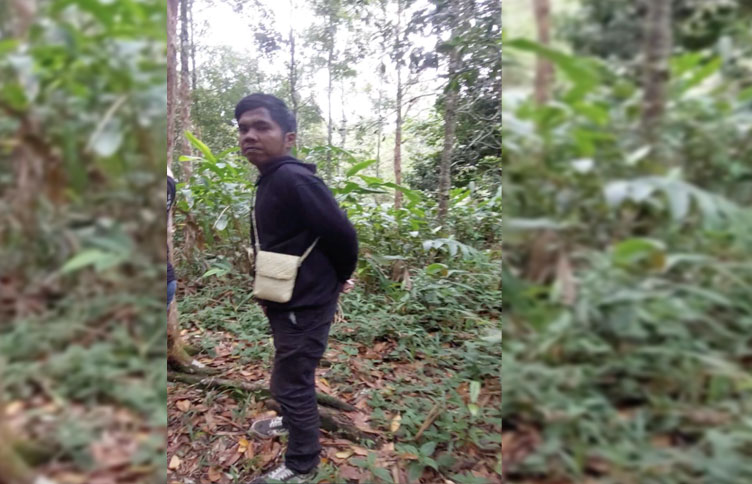
Manogu, inside the Kemenyan Forest.
Peoples Assistance Facility (IPAF) Cycle 6, co-managed by Tebtebba Foundation, Inc., benefiting the Toba Batak who are the Indigenous Peoples living there.
Upon arrival, we were directed to the forest areas, about a 30-minute ride from the village center. Along the way, I observed muddy roads and traces of flooding and landslides as we passed through eucalyptus plantations. In the vast landscape, many eucalyptus trees had been uprooted. I was told this was part of the reforestation efforts of the Toba Batak who are replacing eucalyptus with benzoin trees.
After a while, we reached our destination and walked deeper into the customary forest. Inside stood the kemenyan trees (benzoin trees) — the tree of life for the Toba Batak of Onan Harbangan Indigenous community. Beneath these trees, community members began sharing their narratives.
The Toba Batak of the Onan Harbanagan Community
The Onan Harbangan community (a Bahasa term for “traditional trading village”), populated by the Toba Batak, is located in Nagasaribu, a sub-village of Pohon Jae in North Tapanuli Regency, North Sumatra, Indonesia. Some studies indicate that the Toba Batak belong to the Austronesian ethnic group, originally inhabiting the uplands surrounding Lake Toba. They are known for their well-established culture deeply tied to land and nature — an identity shared by Indigenous Peoples worldwide. The community is composed of 87 families (586 individuals) — 325 women and 251 men. According to KSPPM, the Toba Batak have lived in this community for 14 generations, claiming the area as their ancestral domain.
Historically, Dutch missionaries in the 19th century had a profound influence on the religious character of the Toba Batak, shaping much of their present-day identity. This influence remains evident in the fact that community members are predominantly Protestant Christians. It is a prayerful community: they offer prayers before meals and before and after meetings, usually held in their church, Huria Kristen Indonesia (HKI). One of the village leaders, who actively facilitated the meeting, is a pastor. Despite their Christian faith, the community continues to uphold Adat customs — the Bataks’ customary laws and practices, while maintaining socio-cultural and political organization through the marga or the Toba Batak’s clan system. Ms. Delima, Executive Director of KSPPM, shared that her surname, Silalahi, is one of the prominent clans of the Toba Batak in North Sumatra.
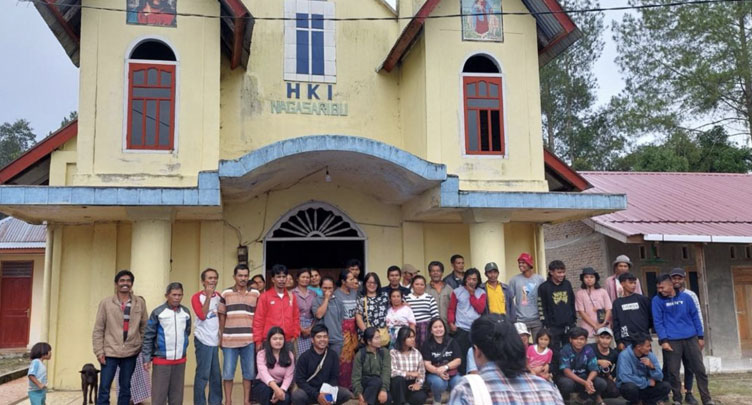
The Toba Batak in Nagasaribu, Onan Harbangan in front of their Church.
Economically, Onan Harbangan depends on the benzoin (kemenyan) tree, an endemic tree in Tapanuli in North Sumatra. They also cultivate staple crops such as rice, corn and yams, and raise buffalo, chickens and pigs. Customary rules govern daily life, shaping both social interactions and engagements with the natural environment. As reported, the community is highly resilient: they maintain their cultural identity and ancestral connection to Lake Toba, while also welcoming modernization and tourism in the North Sumatra region.
Kemenyan Tree – The Tree of Life for the Toba Batak
The benzoin tree (Styrax benzoin Dryand. with local/common name kemenyan) is endemic to North Sumatra and central to the livelihood of the Toba Batak. For generations, it has been a vital source of cash income, significantly contributing to the community’s economy. The tree produces resin, also called sap or gum, through its bark, which is harvested and marketed.
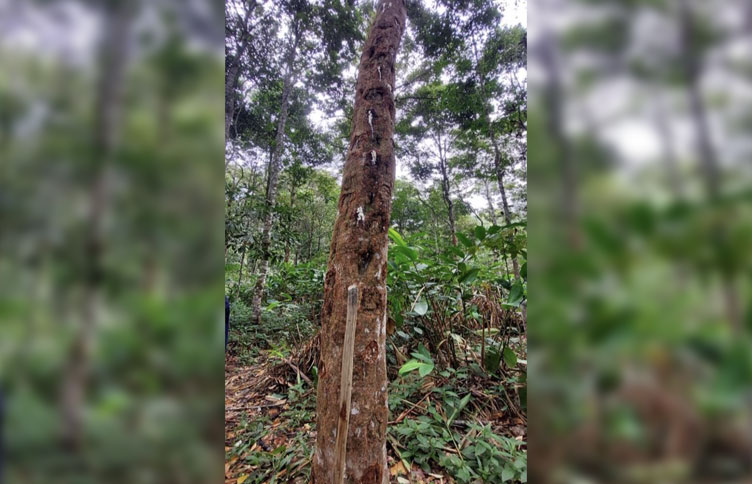
A Benzoin tree in the Kemenyan forest.
Benzoin is sometimes referred to as gum benzoin, gum Benjamin or storax. Its resin is widely used in incense making and perfumery, and in cosmetics and certain medical applications. In medicine, benzoin is used as an adhesive to secure wound and catheter dressings, and it is available in sterile preparations.
Morphologically, the benzoin tree can grow up to 34 meters tall, with a trunk reaching 100 centimeters in diameter and numerous branches. It has a taproot system supported by strong lateral roots, allowing it to anchor firmly into the soil. Benzoin thrives naturally in mixed primary forests with nutrient-rich clay soils at elevations between 100 and 1,600 meters above sea level, commonly within diverse tropical forest ecosystems.
While the benzoin tree is easily recognized for its economic and pharmaceutical value, its ecological benefits are equally significant. It helps maintain ecosystem balance, sequesters carbon to combat climate change and stabilizes soil with its strong root system, preventing erosion and conserving biodiversity. Beyond these contributions and benefits, benzoin rehabilitates degraded land, improves soil fertility and provides wood for domestic use.
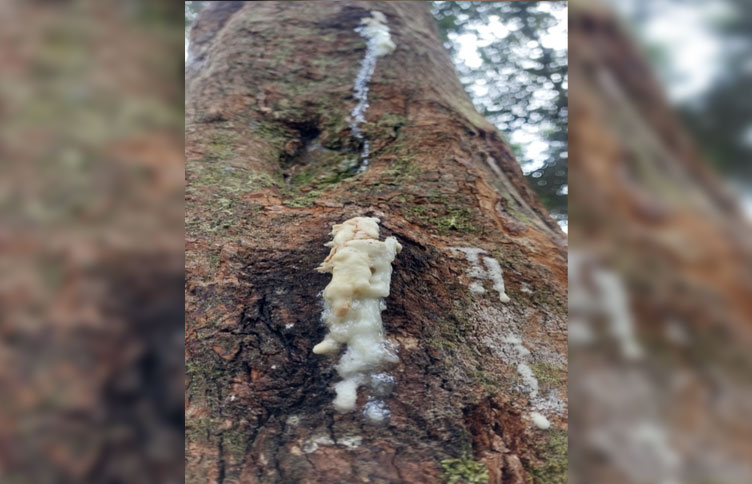
A good quality benzoin sap/resin.
Economically, benzoin resin is the community’s primary source of cash. Prices per kilogram vary by quality, ranging from 75,000 IDR (≈ USD 4.48) for lower grades to 300,000 IDR (≈ USD 18) for the highest quality (based on an exchange rate of 16,750 IDR/USD). A farmer can harvest about one kilogram of resin from a single mature tree per cycle, and 1,500 trees can yield approximately 150 kilograms annually. Resin can be harvested four months after making indentations in the bark. This provides substantial income for the community, and if scaled, the kemenyan forests could contribute significantly to the national economy.
Indeed, the benzoin tree is more than a source of livelihood; it is a tree of life, a cultural and economic jewel for the Toba Batak people.
The Historic and Persistent Fight for Land Rights
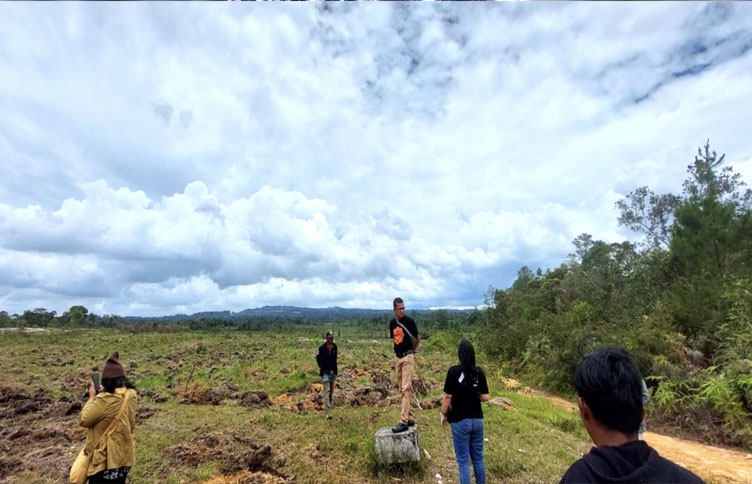
The customary land (tano in Bahasa) of the Toba Batak in Onan Harbangan covers 2,508 hectares. According to KSPPM, the Indonesian government had earlier categorized the entire ancestral land of the Toba Batak in Harbangan as a state forest area. In 1992, it granted a concession license to PT Toba Pulp Lestari (TPL), a pulp and paper company. At that time, villagers were powerless to oppose the government, particularly as TPL, backed by police and some officials, threatened and intimidated them.
Records show that this prominent pulp company in North Sumatra was founded on April 26, 1983, by Sukanto Tanoto, under the name PT Inti Indorayon Utama Tbk. It was listed on the Indonesian Stock Exchange on June 18, 1990, and later renamed PT Toba Pulp Lestari Tbk during restructuring in 2000-2001. As of October 31, 2025, the majority shareholder is Allied Hill Limited, based in Hong Kong, holding 92.54% of shares. Allied Hill Limited is owned by Everpro Investments Limited, reportedly controlled by a Singaporean businessman. TPL’s headquarters are in Medan, North Sumatra, with operations concentrated in Toba Regency. Its plantation and facilities cover approximately 58,392 hectares, including 44,544 hectares of industrial forest plantations and 13,848 hectares managed with third parties.
Since 1987, TPL has faced accusations of environmental pollution, deforestation and worsening natural disasters such as floods and landslides. Its operations have been linked to three major disasters in Sumatra: landslides in 1987 caused by road construction that destroyed farmland and claimed lives; a sewage burst during production testing that polluted the Asahan River; and, most recently, severe floods and landslides in December 2025. The company has consistently denied these allegations, claiming compliance with sustainable forest management principles. Beyond environmental concerns, TPL has also been embroiled in long-term land disputes with Indigenous communities, including Onan Harbangan.
After more than two decades of consolidation, and with support from social development groups like KSPPM, the Toba Batak of Onan Harbangan began to reclaim their ancestral land from TPL in 2016. In February 2022, the Indonesian government issued Customary Forest Decree No. 340/MENLHK-PSKL/PKTHA/PSL.1/1/2022, recognizing and declaring 1,586 hectares as customary forest for the community, of which 300 hectares have been converted into a eucalyptus tree plantation. For the Toba Batak, the destruction of the kemenyan forest represents the destruction of Indigenous lands, resources, ecosystems and food systems. It means loss of income from benzoin resin, loss of clean and safe water due to chemical pollution, loss of biodiversity and loss of medicinal plants.
It is against this backdrop that Project 2763 in partnership with IPAF-IFAD — “Economic, Social and Cultural Rights Fulfillment through Strengthening the Sustainable Governance of the Customary Territories of the Indigenous Peoples of Onan Harbangan,” spearheaded by the KSPPM, was designed, consistent to the Toba Batak’s philosophy, “Tano do marga, marga do tano,” which means “Land is clan, clan is land”. The project intends to contribute to the restoration of the customary forest based on Indigenous systems of knowledge and management to address environmental challenges while ensuring the sustainability of the community’s food systems. Specifically, one project component is to restore polyculture through agroforestry in at least 20 hectares of the 300 hectares. converted into eucalyptus plantation, through reforestation with kemenyan trees, frankincense, rattan, meranti, sampinur, and ingul, among other traditional species. As of the project visit, eucalyptus trees were being uprooted and replaced with kemenyan trees. The community has also started vegetable and rice farming, and cultivation and propagation of fruit and coffee trees.
In the latter part of 2024, however, tensions between the Onan Harbangan Community and the PTL company escalated due to the latter’s encroachment in the project area. The situation came to a head in January 2025 when hundreds of TPL workers, escorted by security personnel armed with batons, attacked Toba Batak members who were guarding their customary territory. The confrontation turned violent, resulting in injuries to villagers and sparking a legal dispute. The company had set up guard posts and cut off community access to the benzoin forest by digging a large hole in the road connecting the settlement to the forest. For more than three months, the daily routine of the community members has been reportedly monitored by drones operated by the company aside from reports of harassment. This has prevented community members from attending to their farms and to the Kemeyan forest, and a temporary restriction of project activities.
The situation necessitated the mobilization of support from the broader civil society. Joint and persistent networking and advocacy efforts by the Onan Harbangan community and the KSPPM resulted to solidarity actions from churches, academics, students and non-government organizations (NGOs) urging the government to protect the Indigenous community, facilitate community access to the frankincense forest, call on police action to address the reported human rights violations committed by the company, and ultimately call for the shutdown of the company.
By the end of 2025, severe flash floods and landslides struck Sumatra and Tapanuli, highlighting the devastating environmental impacts of unsustainable land use. In response, the Indonesian government revoked the Environmental and Forest Utilization Permits of TPL. This decision was welcomed by the Onan Harbangan Indigenous community, as it has created a safer and more secure environment for them to access, manage and carry out activities within their traditional territories.
Reflecting on their journey, Manogu Simanjuntak noted that the community has stood together and fought steadfastly the whole time. The unity, courage and perseverance of the Toba Batak people, combined with the unwavering support of KSPPM through the IPAF 2763 Project, have brought them closer than ever to achieving justice and securing their land rights after decades of struggle. The best is yet to come as the Toba Batak continues to strengthen their agencies through the project with the KSPPM.