

More than just a tourist attraction, the Bomod‑ok Falls holds a deeper meaning for the Indigenous Pidlisan community in Sagada, Mountain Province, Philippines. The Bomod‑ok Falls, known as “the big falls” of Sagada, derives its name from the word bod‑ok, signifying the powerful rush of water there. During the boso or “head‑hunting” period, these waterfalls served as a crucial panenchan (signal or warning) and played a pivotal role in safeguarding the village of Pidlisan. It was also believed that the sound of the water would change, forewarning the Pidlisan people of impending enemy attacks and prompting them to fortify their defenses. Beyond this, the Bomod‑ok Falls is considered a sacred site and continues to play an important role in Pidlisan rituals and traditions. It is frequently invoked in the prayers and chants of the elders, symbolizing both spiritual reverence and practical protection for the community.
In the northern part of Sagada, Mountain Province, the Pidlisan ancestral domain, composed of four barangays, namely Aguid, Pide, Fidelisan and Bangaan, can be found. The residents in these areas identify themselves as iPidlisan. The iPidlisan value different places that hold cultural and spiritual significance in their ancestral domains, which they consider sacred sites and part of their cultural and natural heritage. With a total area of 3,902.48 hectares, Pidlisan’s land is divided among several uses: watershed, pine forest, timberland, rice fields, unirrigated farmland, grassland, orchards, residential areas and a cemetery. It is home to 3,943 people, who make up 574 households and 616 families (Pidlisan Community‑Based Management Information System, Tebtebba, as cited in Española and Sidlakang Mindanao, 2021). These sacred sites can be located in forests, springs and mountains, among other areas, and differ in purpose, location and the specific rituals performed. They play a vital role in the Pidlisan community and in the lifestyle of its people. Sacred sites in the Pidlisan ancestral domain vary in size and nature.
Traditional practices, such as rituals carried out at sacred sites, serve as a vital link to the community’s past and play a key role in promoting their importance, including the transfer of knowledge to the next generation. This can be seen in the dap‑ay, a collective space where most rituals and decision‑making occur. These are important for protecting and managing the site in accordance with customary laws and policies.
In conserving and protecting these sacred sites, the Pidlisan community practices the principles of inayan and lawa, which embody the morals and values of honesty, commitment and truthfulness. These principles reflect the community’s relationship with their environment, especially as it is intertwined with their respect and care for their sacred sites. Documenting practices connected to these areas has enriched the community’s understanding of the significance of their traditions, which need to be maintained and passed on.
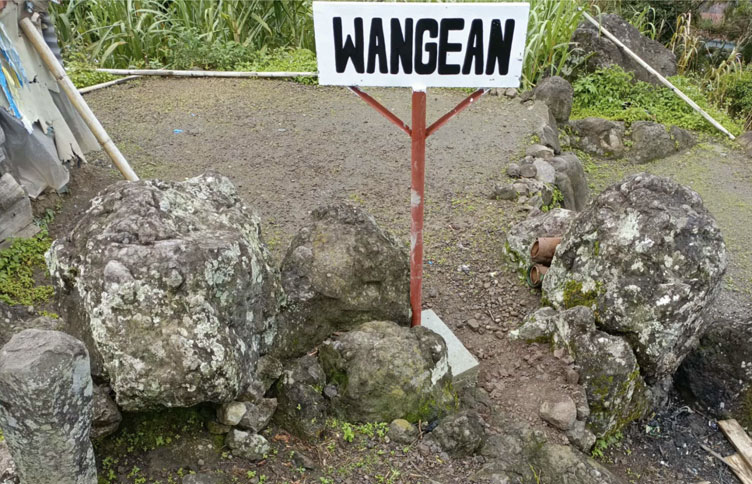
One of the cultural sites marked.
Currently, however, challenges brought by tourism and fast‑growing development projects, particularly infrastructure, have reshaped the structure of some practices and the status of sacred sites. Additionally, because of the kaingin system or swidden farming, sacred sites have been affected, left unrecognized by younger generations and disconnected from customary laws of governance.
These circumstances prompted the need to document all activities that threaten sacred areas and to propose policies and conservation measures. To address these issues, a People’s Organization called the Pidlisan Tribe Organization (PiTO) implemented a project entitled Safeguarding the Natural Heritage and Sacred Sites of the Pidlisan Ancestral Domain. The goal of the project is to safeguard the natural heritage and sacred areas of Pidlisan through collaborative efforts with partner organizations, local government units and other stakeholders, securing their protection and preservation for future generations. The objectives were to list and document natural heritage and sacred areas, enhance community awareness and mitigate and monitor threats to sacred areas within the Pidlisan ancestral domain. Markers were placed at identified sacred sites to increase community awareness of their locations and help protect these areas.
In February and March 2025, a heritage walk was conducted in the mountains, forests, springs and communities within the ancestral domain. Elders, leaders, tribe members and other interested community members participated. These activities contributed to documenting traditionally important areas for the Pidlisan tribe that need to be filed and validated by the community. The sites marked include Pattong, Bangaan, Liwang, Secheyan and Bomod‑ok Falls, among many others. They also continue to reinforce their commitment to safeguarding ancestral lands for future generations through efforts in land‑use planning and resource inventory. In particular, the Pidlisan community has formulated policies to prevent the privatization of communal lands and individual ownership of portions within their ancestral domains. Their initiatives are grounded in Indigenous knowledge systems and practices (IKSPs) that emphasize the balance between human activity and ecological preservation.
These efforts directly contribute to the Kunming‑Montreal Global Biodiversity Framework (KMGBF), a comprehensive international strategy to address and remediate the decline of natural ecosystems, ensuring a sustainable environment for the future. Specifically, the KMGBF is guided by a set of goals and targets to be achieved by 2050. In line with this, their initiative contributes to Target 21 on biodiversity information and knowledge, particularly awareness‑raising and indirectly contributes to KMGBF Target 1 on biodiversity‑inclusive spatial planning and Target 14 on mainstreaming biodiversity in decision‑making.
Through visibly marking sacred sites within the Pidlisan ancestral domain, the iPidlisan community is raising awareness about the customary laws and values associated with these areas, while reinforcing their importance in community planning. This also contributes to activities stated in the Philippine Indigenous Peoples’ Biodiversity Strategy and Action Plan (IPBSAP), such as the intergenerational transmission of Indigenous knowledge (IPBSAP Target 14).
The journey of the Pidlisan community shows that sacred sites are more than cultural markers—they are living testaments to Indigenous resilience and ecological stewardship. By protecting these spaces and passing on their significance to future generations, the iPidlisan continue to uphold their identity while contributing to global efforts for biodiversity and sustainability.