
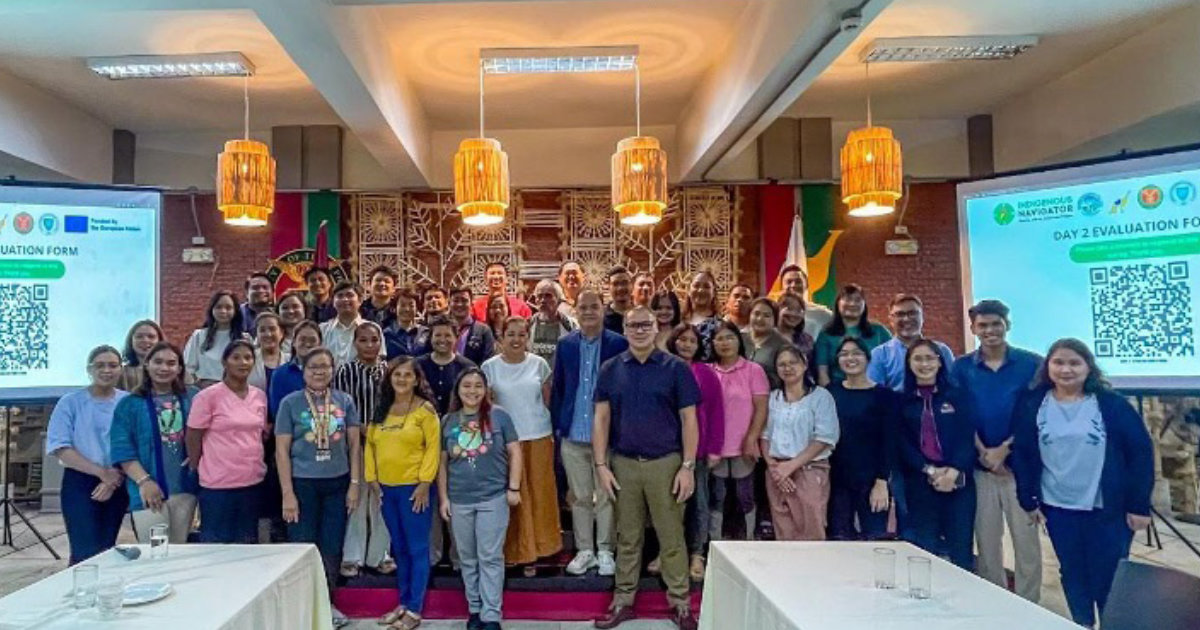
Quezon City, Philippines – A national training-workshop held by the Indigenous Navigator Philippines marks a significant milestone in advancing Indigenous Peoples’ rights and development. Organized in partnership with the Indigenous Peoples International Centre for Policy Research and Education (Tebtebba), Pangasinan Polytechnic College, and the Asian Institute of Tourism, the event took place on June 19-20, 2024 at the Asian Institute of Tourism, University of the Philippines-Diliman, Philippines.
The workshop was aimed at empowering Indigenous Peoples in utilizing the Indigenous Navigator (IN) framework, a set of tools designed to help communities monitor the implementation of the UN Declaration on the Rights of Indigenous Peoples (UNDRIP) and Sustainable Development Goals (SDGs). This event targeted four primary goals: ensuring reliable data on Indigenous Peoples’ rights, producing knowledge products for policy influence, strengthening the Indigenous Navigator consortium, and enhancing Indigenous communities’ capacity to pursue self-determined development.
Victoria Tauli-Corpuz, Tebtebba’s Executive Director and former UN Special Rapporteur on the Rights of Indigenous Peoples, opened the workshop by emphasizing the importance of Indigenous-generated data. “The Indigenous Navigator enables communities to gather their own data to prioritize needs within their territories, determine their development paths, and assert their rights,” said Tauli-Corpuz. She highlighted the need for disaggregated data to support Indigenous Peoples’ rights on both local and international platforms.
In his welcome address, University of the Philippines-Diliman Chancellor Edgardo Carlo Vistan II echoed this sentiment, noting the university’s commitment to preserving indigenous knowledge, or katutubong kaalaman. “The Indigenous Peoples deserve equitable access to development and peace,” he said. Chancellor Vistan anticipates that the IN framework will significantly advance indigenous communities’ rights through participatory data collection and monitoring.
Professor Raymundo Rovillos, Pangasinan Polytechnic College President and National Lead of IN-Philippines, provided an overview of the IN framework, highlighting its utility in tracking Indigenous Peoples’ rights. He explained that the IN surveys combine quantitative and qualitative data to evaluate the status of Indigenous Peoples’ rights and well-being, covering critical areas such as human rights, sustainable development, and local implementation of the UNDRIP.
The workshop also addressed the alignment of SDGs with Indigenous Peoples’ needs. Robeliza Halip of the Indigenous Peoples Major Group for Sustainable Development Coordinator shared insights on how SDGs support the Universal Declaration on Human Rights and other global human rights standards. She reinforced the agenda’s pledge to “leave no one behind”, emphasizing that policies impacting Indigenous Peoples must align with these principles.
Additionally, Judith V. Gondra National Economic and Development Authority (NEDA) outlined the Philippine Development Plan 2023-2028, which envisions an inclusive and resilient society. She underscored the government’s commitment to the SDGs, particularly SDG targets 2.3 and 4.5, which focus on Indigenous Peoples’ rights to equitable development.
Participants also learned practical skills for utilizing the IN portal, an online resource that supports data access and community-led development. Government agency representatives, indigenous organizations and community members discussed current initiatives, challenges and opportunities for collaboration.
Consolidating and Sharing Insights for Future Action
Workshop outputs, including national survey questionnaires and preliminary findings, will be consolidated and shared with participants. A follow-up meeting with government agencies is planned to validate and update the report with recent initiatives.
Funded by the European Union, this workshop represents a continued commitment to recognizing, protecting, and promoting the rights of Indigenous Peoples in the Philippines.