

Yet, challenges and tensions remain. There is a real risk of digital colonialism if Artificial Intelligence (AI) systems are imposed without Indigenous input, replicating historical patterns of exploitation.
Baguio City, Philippines—Lucas Kasosi of the Indigenous Maasai people of Kenya and Tanzania in Africa published a story on the Cultural Survival website about a disturbing misrepresentation by Artificial Intelligence (AI) technologies. The case involved an AI-generated image of a Maasai neck choker used during a public campaign by the Kenyan State Department of Culture in 2024. In the image, one of the most evident missteps was the depiction of the Maasai neck bracelet or choker as being worn by men instead of women. According to Kasosi, this goes far beyond a simple aesthetic mistake.
Adobe also came under fire for hosting AI-generated stock images that misrepresented Indigenous Peoples. The National Indigenous Times reported that Adobe Stock contained AI-generated images labeled as “Indigenous Australians,” many of which did not resemble Aboriginal and Torres Strait Islander peoples. Some figures even displayed random body markings that were culturally meaningless, disregarding the deep significance of traditional markings to specific First Nations groups. Critics, including Indigenous artists and human rights advocates, warned that such inaccuracies perpetuate harmful misrepresentation and raise serious concerns about whether genuine Indigenous artworks were used to train the software without free, prior and informed consent (FPIC).
These cases clearly pierce the principles of Indigenous data sovereignty and strongly affirm the persistence of cultural flattening.
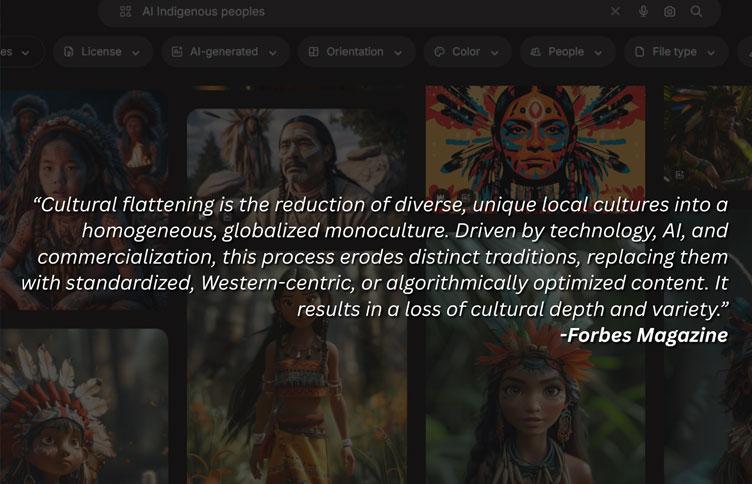
AI exploitation of Indigenous Peoples often takes the form of cultural flattening. This refers to the erosion, homogenization or replacement of unique cultures, traditions and artistic expressions by a uniform, mainstream global culture. Think of it as all the fish in the sea being canned and labeled in a single package, as if they belong to the same species, when clearly, they do not. Through globalization, this foundational dilemma of cultural flattening promotes a “one-size-fits-all” aesthetic and lifestyle.
AI can never fully comprehend the complexities of human existence. Within these complexities lie culture and tradition, elements deeply rooted in identity and community. With the massive rise of AI utilization across all dimensions of society, this technological revolution, which attempts to capture aspects of human consciousness, poses a potential threat to Indigenous Peoples’ ownership and representation of their identity.
In the past, we have seen how technology has gradually undermined Indigenous Peoples’ independence in governance. Machinery and tools have contributed to environmental degradation, disrupted sacred heritage and accelerated the loss of language. Indigenous youth, while turning toward innovative preservation methods, now face tidal waves of misrepresentation brought about by AI within Indigenous rights movements.
According to research, many ethnic groups are misrepresented by AI-generated platforms, reflecting systemic bias in datasets and algorithms. A study on Indigenous representation in AI found that current systems often lack diversity in training data, leading to distorted portrayals of Indigenous identities and cultures.
Even when AI is used with good intentions for representation and creativity, it often produces unsolicited and unchecked inconsistencies in how Indigenous Peoples’ knowledge is depicted, whether in images, videos, language, or other cultural expressions.
Indigenous Peoples’ data sovereignty clearly states their right to own, control, access and possess data that are derived from them,their knowledge systems, customs and territories. Meanwhile, Indigenous worldviews offer a powerful framework for rethinking how AI should be developed and used. Many Indigenous cultures emphasize relationality, the understanding that humans, nature and technology are interconnected. This perspective challenges the dominant view of technology as separate from human life and instead situates AI within a broader living system. Concepts such as stewardship, reciprocity and balance provide ethical anchors that can guide AI toward serving communities rather than exploiting them.
Through an Indigenous lens, AI is not merely a tool but part of a system that must respect cultural values. Indigenous data sovereignty becomes central here, ensuring that communities retain control over how their data is collected, stored and used. Ethical AI, in this context, means aligning machine learning with Indigenous principles of consent, respect and responsibility. Without these safeguards, AI risks perpetuating the same colonial patterns that have historically undermined Indigenous autonomy.
Practical applications of AI demonstrate how these values can be put into practice. AI can support language revitalization by helping preserve and teach endangered Indigenous languages, ensuring that cultural identity remains strong across generations. It can also play a role in environmental monitoring, assisting communities in protecting lands and ecosystems that are vital to their survival and heritage. In healthcare, AI can be tailored to meet the specific needs of Indigenous communities while respecting traditional practices, creating a balance between modern innovation and cultural continuity.
Yet, challenges and tensions remain. There is a real risk of digital colonialism if AI systems are imposed without Indigenous Peoples’ input, replicating historical patterns of exploitation. Bias in AI datasets continues to overlook Indigenous knowledge systems, reinforcing misrepresentation.
To address these issues, collaborative governance models are essential, frameworks where Indigenous voices actively shape AI policy and development. FPIC-focused protocols must include independent mechanisms in AI usage. These directly influence datasets and algorithms and must clearly align with accurate cultural representations. Only through such inclusive approaches can AI evolve into a technology that truly embodies harmony, respect and balance.
These steps directly contribute to validation and belonging, where seeing one’s culture accurately reflected in mainstream media affirms the lived experiences of Indigenous Peoples and fosters a strong sense of value and identity. This, in turn, helps repair long-standing societal biases and stereotypes.
Finally, for Indigenous Peoples, especially the youth, this fosters pride in their culture and strengthens their confidence in their roots.