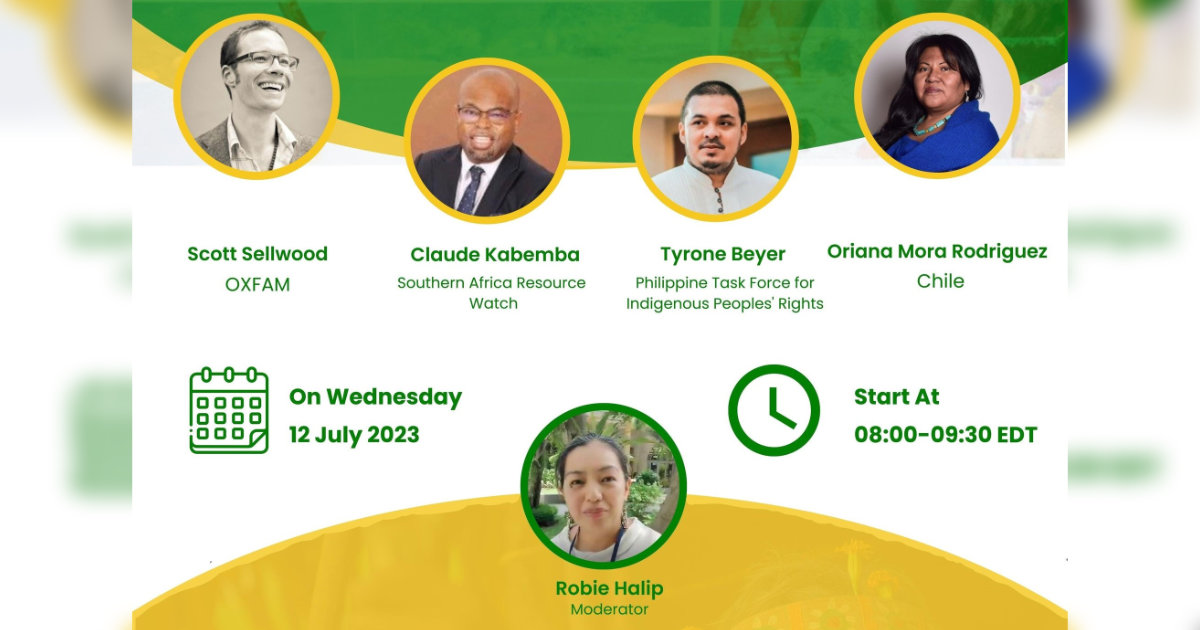
New York, USA - One of the thematic goals reviewed during the 2023 High-Level Political Forum for Sustainable Development (HLPF) is the SDG 7 on Affordable and Clean Energy. A side event to unveil the impacts of mining for clean energy technologies to Indigenous Peoples was initiated by the Right Energy Partnership with Indigenous Peoples (REP) on July 12, 2023 via Zoom, attended by approximately 60 indigenous peoples, civil society organizations, international organizations, and other stakeholders around the world.
“A lot of targets are looking at clean technology but not looking at how these clean technologies are produced. This side event will show how indigenous peoples are affected by these mining [companies] and their recommendations [on] how mining can be just in the perspective of indigenous peoples,” highlighted Robie Halip, program coordinator of the Right Energy Partnership and moderator of the side event.
The side event at the High-Level Political Forum aims to highlight the impacts of mining of transition minerals to indigenous peoples and how the transition to renewable energy should be rethought as it currently entails more extraction and destruction of the environment and is violating the rights of indigenous peoples.
The Right Energy Partnership with Indigenous Peoples
Right Energy Partnership’s executive director, Adrian Lasimbang, delivered his opening remarks and provided a brief overview on what REP is doing. He mentioned that, because we are forced by climate change to transition to low carbon energy sources, we usually look at solar power sources that require storage and that a lot of materials are sourced from indigenous territories. Included in REP’s programs is the facilitation of community-led renewable energy systems for the communities. Lasimbang highlighted that REP also advocates for indigenous peoples’ rights related to renewable energy.
“We are very committed to making sure that renewable energy is truly sustainable,” Lasimbang added. He cited that many discussions are happening now on just energy transition but not so much on where these minerals have been extracted from.
“We have to move beyond what we call business as usual because while transitioning from traditional fossil fuel, we have the chance to transition [to how] we extract these minerals and resources from the ground to make sure that it is truly sustainable… It is important to know the effects of mining [on] indigenous peoples’ communities,” he concluded.
The side event had four speakers–three shared the case studies they worked on relating to the effects of mining to indigenous communities and one was a global movement working with communities for social justice.
Monitoring the impacts of mining to communities, DRC
Claude Kabemba, a political economy expert and the director of Southern Africa Resource Watch, who works for the promotion of transparent, accountable, and equitable management of resources in Africa, shared a case study they conducted investigating/monitoring the impacts of Tenke Fungurume Mine, operated by the Chinese company China Molybdenum (CMOC), which mines copper and cobalt minerals in the province of Lualaba in the Democratic Republic of Congo.
Kabemba started his presentation by providing an overview of the mining status of the DRC while emphasizing that the country is one of the richest countries in terms of minerals and critical minerals that are important to secure a sustainable energy transition. He added that the DRC is the largest producer of cobalt at present, providing 67% of its total production worldwide and is also the first African country to do so. In the same note, Claude expressed that DRC discovered a very big reserve of lithium and manganese which are also two important implements in securing energy transition.
“These minerals are not new minerals in [the Democratic Republic of] Congo. These minerals have been extracted for centuries and the only things that have changed now are the intensity of extraction and the increase of its impacts,” Kabemba stressed. He also pointed out that the extraction did not create wealth for the Congolese people, rather, that these extraction activities left them with poverty, pollution, and the degradation of their environment.
As mentioned by Claude, the concept of “indigenous peoples” 'is generally accepted by the government and civil society of Congo but that the constitution and laws of the country do not explicitly mention indigenous peoples in words or otherwise.
The case study revealed that mining minerals in the province severely impacted the indigenous peoples. Since mining started, many have been displaced, indigenous women have had health problems, and water has been contaminated, among other impacts. Claude mentioned that the findings of the case study were shared to the government and mining companies including some of the recommendations that companies should provide housing to displaced communities. Unfortunately, the government was too weak to push companies to respond to these recommendations. “Free, prior, and informed consent (FPIC) [was] never applied to any circumstances during, before, or even now that they are expanding--no consultations were done,” Claude disclosed. The case study also revealed that mining activities in the area attracted people from the outside who were hoping for employment and that indigenous peoples in the area were being excluded from the benefits and their voices were not being heard and shared.
“It’s a contradiction to have a resource that is important for the world economy to be extracted from a land with extreme poverty,” Claude emphasized.
Nickel Mining in the Philippines
Tyrone Beyer, a Tuwali from the province of Ifugao in the northern Philippines and the campaign and advocacy officer of the Philippine Task Force for Indigenous Peoples Rights (TFIP_, a non-government organization for the service of indigenous peoples, shared a case study on nickel mining in Sofronio Española in Palawan, Philippines.
Prior to sharing the study’s findings and recommendations, Tyrone mentioned laws existing in the Philippines in relation to mining including the Republic Act 7942 or the Philippine Mining Act of 1995, a law that provides for Financial and Technical Assistance Agreement (FTAA), Mineral Production Sharing Agreement (MPSA), and Exploration Permit Agreement (ExPA). Beyer added that this law is controversial because it heavily favors foreign mining corporations and promotes the immediate export of raw minerals to industrialized countriesThe law allows the ownership or joint venture of foreign corporations (40%) share except for FTAAs which allows 100% ownership of mineral rights.
Beyer also presented the active mine sites in the Philippines as of November 2013, noting the dominance of nickel, the most mined mineral by large mining companies that are operating in the country and the main material for creating electric vehicles. He noted that the Philippine government launched the Public Utility Vehicle Modernization Program to replace the traditional jeepneys to modern jeeps (e-jeeps) and modern buses (e-buses).
Tyrone shifted to presenting the mining operations of Citinickel Mines and Development Corporation (CMDC) in the municipalities of Narra and Sofronio Española in the province of Palawan. CMDC holds a mining permit effective 2007 to 2032 covering 2,176 hectares of land. According to the Philippine Center for Investigative Journalism (2022), CMDC boasted a production of 499,573 dry metric tons of nickel amounting to one billion pesos in 2020.
The case study presented by Beyer revealed that the mining activities in the area impacted the Palaw’an people including the decline of livelihood mainly from fishing, a 50% decline of yield for crops, a negative effect on burial grounds and sacred sites, the endangerment of traditional practices, and indigenous women being burdened and pressured, among others. It also revealed the flawed FPIC process that the company has undergone.This meant that CDMC acquired the mining rights from Platinum Group Metals Corporation in 2007 through a memorandum of agreement with the communities without the FPIC requirement.
The recommendations of the case study were also shared,comprising the review of the Indigenous Peoples Rights Act (IPRA) and the amendment of the sections that weakened indigenous peoples’ claim to their ancestral lands.
“Ensure complete, participatory, and indigenous community-led FPIC process. Act strongly upon violations such as penalizing offenders up to upright rejection of the project, policy, or investment,” Beyer emphasized.
Other recommendations of the case study included repealing the Philippine Mining Act of 1995 and establishing grievance mechanisms for indigenous peoples and creating safe venues for engagement between Indigenous Peoples and mining companies.
“Let the Philippine mining industry serve a robust and inclusive national economy for the Philippines. The purported benefits of electric vehicles over vehicles using fossil fuels must be studied first with the participation of the Filipino People, including Indigenous Peoples,” Beyer concluded.
Consequences and Impacts of Lithium Mining, Chile
“As Indigenous Peoples, we view water as the blood of the earth, we view this place’s biodiversity being threatened.”
Oriana Mora Rodriguez, an indigenous woman from Atacama desert in Chile, expressed her reflections as impacts of lithium mining in her community are becoming more visible and adverse.
Rodriguez shared that Chile has more than 50 salt lakes and most are found in indigenous territories. It has now been deemed to be exploited for lithium mining. Additionally, one area in Chile is considered as one of the largest sources of lithium in the world with 21 indigenous communities around it. "Companies extract lithium and copper and they use water from the lakes and use the lands in our area," Oriana commented.
During the side event, Oriana revealed that in the past, conversations only happened between the government and the mining companies while indigenous peoples in the area have been calling for inclusion in the consultation processes. Additionally, indigenous peoples question the profit they could be getting from these projects.
Aside from contamination of water and dropping of water level in lakes because of metal exploitation, Rodriguez also mentioned other impacts of the lithium mining in the Atacama desert including but not limited to biodiversity loss, violation of collective and human rights, loss of livelihood, decrease in number of birds (specifically flamingos), and drying of forests, among others. She also noted that the right to self-determination of indigenous peoples has been affected.
In conclusion, Oriana shared her reflection on the National Lithium Strategy mentioning that one of its objectives is having a dialogue with indigenous peoples and that, so far, they have had two meetings. “We do not know if they will accept the right of communities to reject the lithium strategy, which the government wants to implement rapidly by 2023,” she shared. Rodriguez finished her presentation by leaving a question, “Is such a transition fair or is it not fair?”
Recharging Community Consent
Oxfam policy lead on Extractive Industries, Scott Sellwood, unveiled the initial results and preliminary findings of the report that Oxfam was launching.
Sellwood started his presentation by sharing that for the past two decades, Oxfam has worked alongside communities impacted by mining, oil, and gas projects to ensure governments, companies, and investors are held accountable for protecting and advancing human rights, climate justice, and fighting inequality.
“For indigenous peoples, the principle of FPIC represents a critical tool for doing this by ensuring they have a say in whether and how mining moves forward in their territories,” Scott stressed. The policy lead shared that in their research, they selected five transition minerals (lithium, nickel, manganese, cobalt oxide, and aluminum oxide) to focus on because of their importance as inputs into rechargeable lithium-ion batteries.
The said report highlighted that indigenous and frontline communities whose land rights are not protected are especially vulnerable to a mining sector expanding under these conditions. Sellwood then shared that a recent global sample of over 5,000 mining projects found that 54% of transition mineral projects were located on or near the lands of indigenous peoples. A second study also found that 80% of the 700 mining projects for transition minerals in countries implementing the Extractive Industries Transparency Initiative (EITI) were located near or in the territories of indigenous peoples.
Scott raised that Oxfam expects companies to fully implement their policies, including identifying salient human rights in their operations, taking concrete steps to mitigate these risks, providing effective remedy if impacts occur, and reporting policy on progress.
“For this research, our focus on publicly available policy commitments should not be seen as more important than efforts to monitor the implementation of those commitments in practice,” Sellwood added. Oxfam recognized that corporate policy commitments are often not translated into practice, especially when it comes to community consent.
The research’s preliminary findings included the fact that the battery mining sector was not sufficiently ready to support a just energy transition under current company policies. While many,though not all, of the studied companies have policies recognizing a commitment to indigenous peoples, human rights, and/or gender equity, these policies frequently suffer from major limitations.
“Oxfam recognizes that gender-responsive decision making is fundamental to good community engagement and consent process,” said by Scott Sellwood.
Sellwood’s presentation ended by concluding that “failing to report community rights will ultimately delay the transition, with more and more communities organizing to defend their rights and sacred place”.
After the presentations of the four speakers, a question-and-answer portion was moderated by Robie Halip, which created a discussion around the topics of consent, impacts to communities, engagement with the state and private companies, and next actions for the transition to renewable energy, among others.