
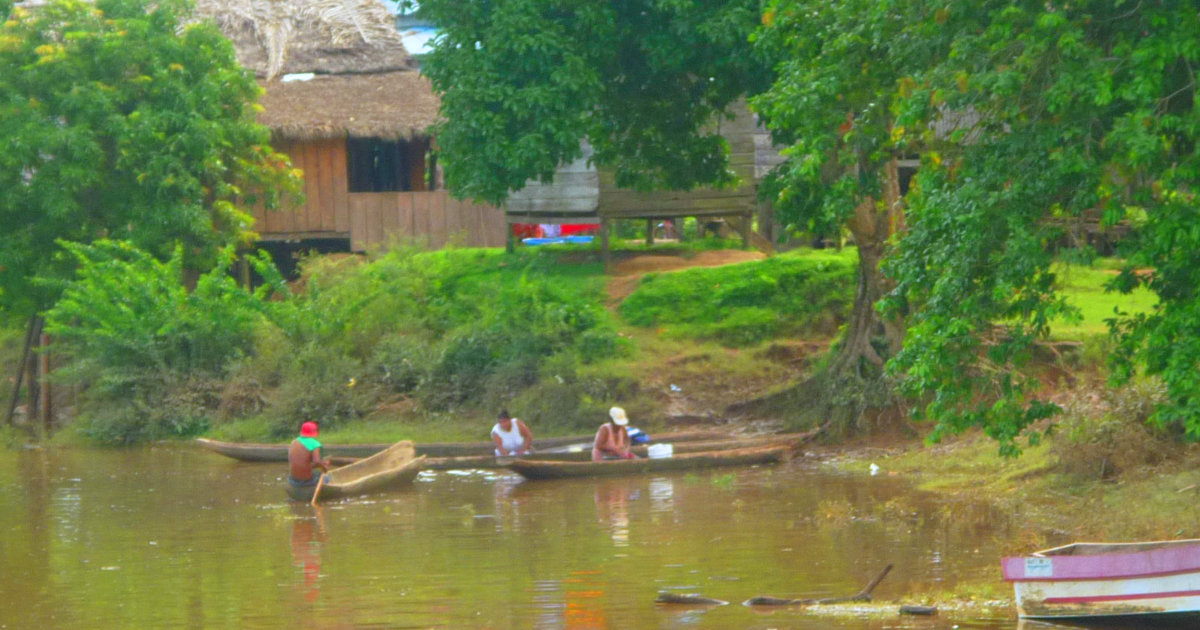
Twenty indigenous leaders from Peru, Nicaragua, Paraguay and Brazil participated in the training on indigenous peoples’ self-determined sustainable development held in Bilwi, Puerto Cabezas, Nicaragua in July 2023.
The training focused on several themes including the multiple crises that indigenous peoples (IPs) are confronting, individual and collective human rights of IPs, United Nations (UN) bodies and human rights mechanisms relevant to IPs, indigenous women, traditional knowledge, territorial governance, and indigenous peoples’ economy, among others.
Along the way to Bilwi, leaders from the Sumu Mayangna nation received the participants from Paraguay, Peru and Brazil at their community center in Rosita in the North Caribbean Autonomous Region. They shared about their people, their territories, and especially about their experiences on territorial management. They highlighted their holistic governance strategies, which include governance of Mother Earth, intercultural education and language, revitalization of traditional knowledge, communications systems, and others.
As part of the training, the participants visited the seat of the Autonomous Regional Government of the Caribbean Coast of Nicaragua in Bilwi, Puerto Cabezas. The regional governor, Mr. Carlos Aleman Cunningham, and some key autonomous regional government officials oriented them about the structure and the significant functions and development initiatives of the autonomous regional government.
The community trainers also drew maps of their territories and identified the resources within. They expounded on the importance of these resources to them as indigenous peoples in these territories. Additionally, they explained the resource management systems they employ as well as the threats to their lands, territories and resources.
During the training, the participants highlighted that indigenous women’s free and effective participation and inclusion in political spaces as well as leadership skills need to be strengthened. They stressed that sexism, machismo, discrimination and violence against women must be eliminated. In the same event, they committed to respect, support and strengthen indigenous women and their organizations, to fight for indigenous women’s rights, to eliminate machismo and work against discrimination, and to support the struggles of indigenous peoples, among others.
As part of the event, the community trainers, also leaders in their communities, drafted their political action plans. They defined their objectives and the results they desired, identifying also the relevant actors. Their plans also reflected the strengths, weaknesses, threats and opportunities deemed.
Dr. Mirna Cunningham Kain, chair of the Pawanka Fund, and Eileen Mairena Cunningham, member of the technical secretariat of the Indigenous Peoples’ Major Group for Sustainable Development, were the main facilitators and resource persons. Other resource persons joined the training and shared relevant information. Nadia Fenly, Research Officer and Impact Issues of Foro Internacional de Mujeres Indígenas (FIMI), introduced the structure and works of FIMI which is the international forum of indigenous women’s organizations based in different countries. Ronald Witinggham, the leader of the Karata community, shared the history of his community including their autonomous governance system.
The training is a component of the capacity-building program for next-generation indigenous leaders being implemented by Tebtebba, Elatia Training Institute and ELATIA partners, with support from the Brot für die Welt/Bread for the World. The training was made possible through the coordination and facilitation of Centro para la Autonomía y Desarrollo de los Pueblos Indígenas (CADPI) in Nicaragua with support from other ELATIA partners in Latin America (Federación por la Autodeterminación de los Pueblos Indígenas ( or FAPI in Paraguay, CADPI, Conselho di Roraima or CIR in Brazil, and Centro de Culturas Indígenas del Perú or CHIRAPAQ in Peru), Fondo para el Desarrollo de los Pueblos Indígenas de América Latina y el Caribe (FILAC), and the Autonomous Regional Government of the Caribbean Coast of Nicaragua.